
Employee satisfaction and motivation are crucial for employers. Prioritizing employees’ needs, including incentives, workload, and workplace environment, directly impacts their performance. This is especially true in today’s hybrid work era, where office design must support both remote collaboration and in-person engagement. Therefore, designing office spaces with a focus on employee well-being is essential for fostering a positive work culture and achieving optimal results.
Find out all about the psychology of office design and how it affects employees’ satisfaction and productivity.
The Undeniable Potential of Psychology of Office Design
Working in a cubicle or in the midst of constant distractions is something employees universally dislike. This situation can lead to lower productivity and higher turnover, outcomes that no organization aiming for long-term success can afford to ignore.
Psychological fact:
Your attitude toward work is heavily influenced by the design of your workspace.
If your office design doesn’t align with your employees’ working styles or fails to bring out their best, you will likely see a considerable drop in productivity, work quality, and employee satisfaction. This concept is also backed by environmental psychology – the study of how individuals interact with their physical environment.
Environmental Psychology About Workspace Design
Here’s how environmental psychology explains the impact of workspace design on employees.
1. Employee Happiness
Your workspace design should inspire your employees and promote positivity in them. One of the most significant factors that affect creativity and happiness is the restriction on where and how they work. Constricted workspaces, confining extroverts in cubicles and introverts in shared offices, can be a significant blow to their morale and enthusiasm. Thereby, it is substantial to make your employees feel comfortable in their workspaces.
2. Productivity
Ventilation, noise pollution, and lighting are factors that you probably already know affect employees’ productivity. But you might be overlooking some lesser-known aspects, such as color, layout, flexibility, and functionality.
For instance, bright colors, especially shades of orange and yellow, are known to spark imagination, creativity, and inspiration. Talking about noise, some individuals prefer quiet and peaceful spaces, while others require shared spaces for better collaboration.
In this case, devising a general solution can be challenging. Thus, it is better to have a flexible workspace that allows you to cater to every individual’s working style.
3. Attract Good Employees
Top candidates look for a supportive work environment that helps them grow and perform at their best. Thus, the right office environment is essential to attract valuable employees.

Every workplace has a certain vibe, reflected in its physical environment and the people within it. That vibe is what potential employees look for when they visit your office for an interview. They picture themselves working in your office and how it would make them feel.
Apart from noticing the office setup, they also observe how happy and positive your employees are about their jobs and workspace. Therefore, maintain an inspiring, productive workspace to encourage candidates to readily accept your job offers.
4. Retain Talent
Companies these days are providing recreational rooms for employees to boost their interest and productivity. For instance, Google’s office has a rooftop garden, a swimming pool, a climbing wall, and several other amenities for its employees’ happiness and satisfaction. Likewise, Foursquare’s office has rooms with various themes to suit different employees’ interests and create a comfortable environment for them.
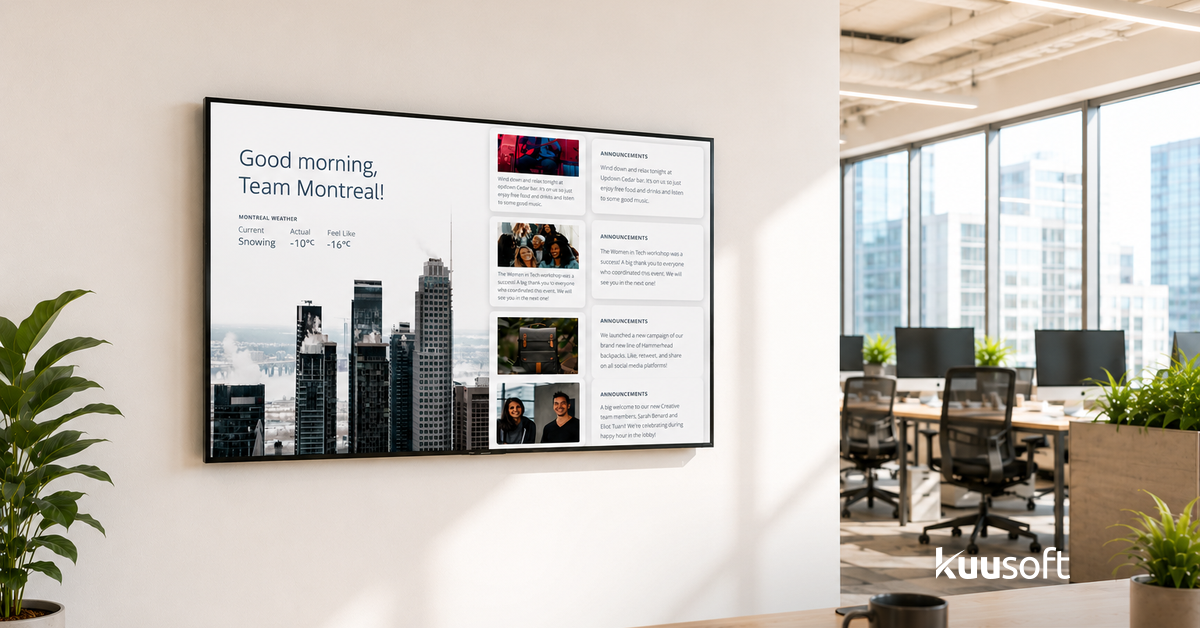
A lot of corporate offices are also seen placing digital signage for improving communication and boosting employee morale. They can be used to display the success of a project, employees’ performance, and a lot more, all of which improve employees’ motivation.
This is the effective execution of environmental psychology at work. Although, for some old-school employers, it may seem like paying employees to play, creating an enjoyable work environment attracts and retains talent, boost creativity, morale, and innovation – the ultimate ingredients for a company’s growth.
How to Create an Appealing Office Design
You do not necessarily need a pool or a gym to create an attractive workspace design. Instead, it can be done following some simple ways given below.
1. Digital Signage
Better communication and customary appreciation boost employee morale and motivation. One of the easiest and most attractive ways to achieve this is by placing digital signage throughout the workspace. You can use them as a quick and easy means of communication that can timely deliver your messages without either of you having to move around. The collaborative environment it creates makes work more manageable than ever before.
Apart from that, you can use digital signage to show how much you care about your employees. Use it to send messages of appreciation for individuals or teams to motivate others—share photos, videos, and achievements to show how proud you are of your people.
You can use it to share progress with your team, set a countdown for a product launch, display your target, give out invitations, and a lot more.
2. Work-Life Balance
Millennials have started to flood the workforce. There’d be hardly any organization around the world without a millennial working in it.
Here’s the thing: millennials tend to be more demanding than previous generations. One of their top requirements is work-life balance, they expect their work experience to be as rewarding as their paycheck. Furthermore, millennials have little hesitation in changing jobs if the workplace doesn’t provide the comfort and flexibility they want.

You can improve employee retention by providing a flexible work environment and freedom in working conditions. This approach makes employees feel valued, resulting in a more enjoyable workplace.
3. Mindfulness
Furniture, fixtures, lighting, colors, common areas, etc., are some general features of every workspace. However, some offices are more motivating and better aligned with employees’ work styles than others—the difference often comes down to mindful design.
When designing your workspace, you have to be mindful of your furniture’s placement, the color of the walls, the heights of the tables, the amount of ventilation, and a dozen other factors. According to a study by Cornell University, optimizing natural light in the office significantly improved workers’ health and productivity. Natural light exposure also boosts mood and creativity, helping employees feel and perform better.
4. Noise Control
Noise is one of the top distractions in modern open offices. According to a study published in the Journal of Environmental Psychology, noise distractions reduce task performance by up to 66%. That’s where acoustic planning comes in.
Creating quiet zones, installing sound-absorbing panels, or providing acoustic phone booths can significantly improve concentration. Carpeting, ceiling baffles, and strategic furniture placement can also help dampen noise.
Digital signage can also support noise management by displaying real-time availability of quiet zones, meeting spaces, or focused work areas, helping employees find the right environment without verbal interruptions.
Allowing employees to choose between collaborative and silent zones gives them the flexibility to work in the environment that best suits their needs.
5. Hybrid Work & Flexibility
As hybrid work becomes the norm, offices must be more flexible than ever. That means designing spaces that support both remote collaboration and in-person productivity.
Some ideas include:
- Modular furniture that can be rearranged for teams or individuals
- Hot-desking stations for part-time office users
- Video conferencing rooms with soundproofing and integrated tech
- Digital signage to communicate updates, hybrid team schedules, safety protocols, or meeting room availability in real time.
Incorporating digital signage enhances hybrid work by keeping both on-site and remote employees informed and aligned. Strategically placed screens can also display recognition messages, upcoming events, or live performance dashboards, which strengthens a shared company culture across locations.
Designing for hybrid work ensures that office space remains relevant, efficient, and supportive of every employee’s unique schedule and work style
Bottom line: Psychology of Office Design
The theory behind the psychology of workspace design shows us how to create a healthy work environment that ensures talent retention in the long run. Organizations are significantly investing in employees’ well-being and happiness. The simplest way to do that is by maintaining a work-life balance, ensuring a mindful design, and incorporating digital signage.

You can learn more about NexSigns’ Digital Signage solution and connect with us on Facebook, LinkedIn, Twitter, and YouTube to get the latest info on digital signage!

Anita Sun
Reimagining technology, creativity, and humanity with Kuusoft Corp.


